

Publication Date
2025
Document Type
Book
Description
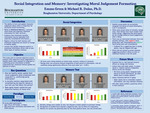
This study investigated how emotional and explicit relational information interact in memory and guide our opinions of people. Participants viewed faces paired with two moral behaviors that were either congruent (e.g., positive-positive) or incongruent (e.g., negative-positive). Participants provided morality ratings of these faces after each behavior. After a delay, it was assessed whether participants remembered their opinions of the people they studied, as well as whether they remembered the actual behaviors those people performed. Initial results show that participants successfully update their ratings of each face, integrating both behaviors into their ratings, even when incongruent. After the delay, the same pattern of morality ratings generally held, though it was overall weaker, suggesting the strong opinions formed in the moment were not held with the same intensity. Interestingly, this pattern was only present when participants remembered explicit details about each face, suggesting morality judgments and explicit memory are perhaps intertwined.
Files
Download Full Text (391 KB)
Recommended Citation
Green, Emma and Dulas, Michael R., "Social Integration and Memory Task: Investigating Moral Judgement Formation" (2025). Research Days Posters 2025. 60.
https://orb.binghamton.edu/research_days_posters_2025/60