
-

Rivers and Industry: The Environmental and Economic Evolution of Broome County
Zachary Hood
This research paper aims to analyze how the confluence of the Susquehanna and Chenango rivers in Broome County has impacted the industrial and economic development of the area, from the arrival of the first European settlers to modern times. The general methodology for research gathering of the paper revolves around historical analysis, utilizing data from the county, state, private firms, and independent studies to develop a foundation. The paper places less emphasis on generating new data and instead focuses on analyzing and compiling preexisting information to reach new conclusions. Generally speaking, even with the unique topography of the area, both rivers have not seen much commercial use beyond the fertile lands they provide in their immediate basins. Despite the lack of commercial utility, the rivers’ occasional flooding has had significant negative economic impacts on the county.
-

Training and Evaluation of Nurse Practitioner Students on the Utilization of Patient Health Questionnaire Depression Screening Tool in Adults in a Health Care Setting
Joanne Hudkins
Depression is one of the most common mental health conditions in the United States. The U.S. Preventive Services Task Force (USPSTF) recommends routine depression screening for all adults to enhance early detection and improve overall health outcomes. Research has shown that screening significantly helps address the social, economic, and health challenges faced by individuals with depression. The Patient Health Questionnaire (PHQ) is a valid and reliable tool for diagnosing depression and monitoring responses to treatment. This project aims to evaluate whether educational presentations on the PHQ-2 and PHQ-9 standardized depression screening tools can improve nurse practitioner students' knowledge regarding depression screening across various practice settings. Thirteen nurse practitioner students participated in the program and completed a pretest and posttest to assess their education. The results confirmed a significant change in the mean scores for participants' knowledge post-intervention. This demonstrates an improvement in the nurse practitioner students' knowledge of using PHQ-2 and PHQ-9 for depression screening following the educational session.
-

Lessons from the History of Automation: The Case of the Luddites
Jia Kai Hu
The consequences of technological innovation on work and employment are hotly debated in the US today. While many fear that new technology like AI automation will supplant human workers, others argue that innovation will create new jobs to compensate for this loss. However, unemployment is only one of the effects. Offering a historical parallel to this contemporary debate, this project turns to the British industrial revolution and the textile workers’ Luddite movement that responded to income and job losses with protests and machine-breaking. While on the surface level, the story of Luddites seems like one about technological unemployment, further analysis reveals other consequences such as deskilling, less worker power, and an increase in social unrest. Using an analysis of the Luddite history and modern quantitative data on the effects of AI on different industries, this research will suggest how this misunderstood history can help illuminate our current moment.
-

Parental Incarceration, Family Punishment
Hatim Husainy
The United States of America has the second-highest incarceration rate in the world, with almost two million people behind bars. Of the incarcerated people in this country, more than half are parents. When the state imprisons a parent, what happens to their children? This project will examine the effects of parental incarceration on children and what can be done to remedy these effects. Effects of parental incarceration range from an increased likelihood of suspension and lower academic achievement to an increased likelihood of obesity and asthma. Despite this, the issue receives little attention, and significant changes have not been made to address it. This project will analyze contemporary data and utilize a thorough literature review to evaluate the recent changes in this problem and the novel approaches to decreasing or solving it, from changes in jurisprudence and law to shifts in prison and social policies.
-

Universal Basic Income as Indigenous Reparations: Connecting Economic Sovereignty and Land Justice
Matthew Ilario
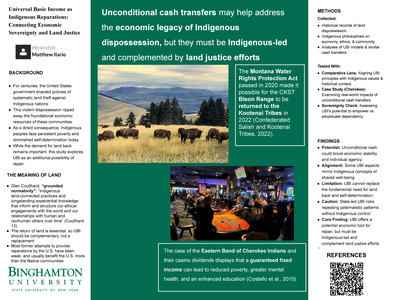
Indigenous land dispossession by the United States has resulted in long-term economic marginalization, restricting access to wealth, resources, and self-determination. Land restitution is a central demand, but Universal Basic Income (UBI) is now considered as a potential tool for economic reconciliation. This research explores whether UBI could function to redress historic land loss, consistent with Indigenous ideas about shared resource and collective well-being. Drawing on Indigenous economic philosophies, such as land and resource sharing, policy tools like the First Nations Fiscal Management Act, and demonstrations of community-run financial initiatives in North Carolina and Canada, this project will consider whether UBI could further Indigenous sovereignty without constituting a replay of paternalistic state policy. Ultimately, this study argues that UBI alone cannot replace Land Back, but can hopefully serve as a tool to restore economic sovereignty and reverse historical injustices in forms amenable to Indigenous norms of mutuality and reciprocal aid.
-
Exploring Gut Biofilm Dynamics: Effects of TiO₂, Antibiotics, and Probiotics in the Small Intestine
Shirmin Islam, Jacob V. Tanzman, Gretchen J. Mahler, and Cláudia N. H. Marques
Chemicals like nanoparticles and antibiotics are increasingly used in daily life, raising concerns about their effects on gut microbiota. Titanium dioxide (TiO₂), a common food additive, and antibiotics can disrupt microbial communities, affecting gastrointestinal function and contributing to gut-related diseases. Microbial disruption may be alleviated by probiotics, known for stabilizing and protecting the gut microbiome. This study focused on the small intestine, a key site for nutrient absorption, microbial diversity, and immune regulation. The hypothesis was that probiotics could mitigate the effects of TiO₂ on a synthetic small intestine microbiome. A biofilm of four bacteria was established, and probiotics, TiO₂ and doxycycline were introduced separately in the system. Probiotics did not affect the healthy gut microbiome, indicating its stability, which is beneficial as it shows probiotics do not disrupt normal gut conditions. TiO₂ and doxycycline had dose-dependent effects, particularly reducing S. salivarius. These findings highlight the probiotics do not have any effect on health microbiome, TiO₂ and doxycycline have selective impacts on gut microbial communities.
-

The Effect of Aging on the Relationship Between Spatial Relational Memory and Intelligence
Ashley Jakubowicz and Taylor Brown
Fluid intelligence, crystalized intelligence, and relational memory are often tied to separate brain processes, but are also correlated with each other. The interaction between these effects, and how they are impacted by aging, has not been fully studied. This study examined interactions between fluid/crystallized intelligence and spatial relational memory for real vs. abstract stimuli. Relational memory was measured via a spatial reconstruction task, and correlated with standardized measures of fluid vs. crystallized intelligence. Spatial memory of abstract objects uniquely correlated with fluid intelligence, while spatial memory for concrete objects uniquely correlated with crystallized intelligence. These data suggest spatial memory is not a unitary process and that performance relies on 1) general hippocampal memory processes and 2) unique prefrontal fluid vs. semantic processes, depending on stimulus type. These data also suggest there may be unique age-related trajectories of Spatial Memory vs. Intelligence depending on the nature of the stimuli.
-
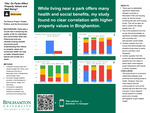
What Impact Do Parks Have on Their Community?
Elliott James
How do parks benefit people and how do they affect housing prices? Parks play a crucial role in enhancing the quality of life for individuals and communities while also influencing local housing markets. To explore these questions, a survey will be used to collect data from many college students, who will be asked about various aspects of how they believe parks can be beneficial to themselves as well as others. There will also be analysis of housing prices at different relative distances away from parks in Binghamton. The survey, along with the analysis of the housing price data, will offer insight into these questions. The data is expected to find evidence supporting that people believe parks benefit them and that they positively impact their lives. It is also expected to find a trend that housing prices tend to rise the closer they are to a park.
-

Intraracial Conflicts: The Rise of ‘Gentrification of Color’ in Asian Ethnic Enclaves
Jocelyn Jao
New York City’s Chinatown is not what it used to be. The Asian ethnic enclave experienced a sharp decline in residents between 1990 and 2020 because of gentrification in the area, specifically gentrification of color. Gentrification of color is a recent phenomenon occurring across America where affluent ethnic minority populations gentrify enclaves of their own ethnicity. Scholars have focused on interracial conflicts induced by gentrification, but the consequences of gentrification of color, especially between socio-economic classes, remain unexplored. By analyzing newspaper articles, oral histories, and archival materials, this paper traces the socio-economic effects of gentrification of color in two of New York City’s most prominent Asian ethnic enclaves: Chinatown and Flushing. Among other things, this study finds that gentrification of color displaces lower-income residents while highlighting intraracial class disparities and exposing conflicting interests that are concealed under the notion of ethnic solidarity. It aims to inform future urban planning policies.
-

The Daughters of Mother Nature
Grace Johnston
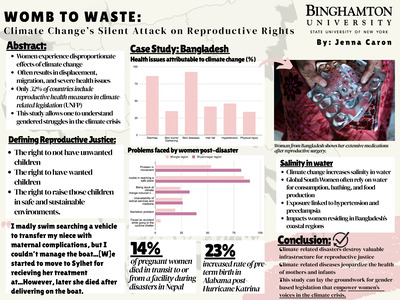
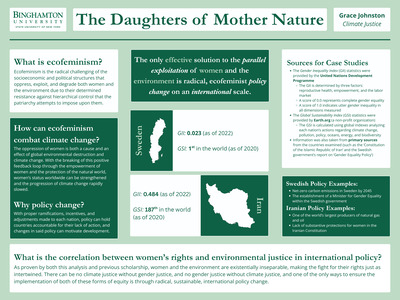
Despite the apparent commitment in the discipline of climate justice to the inclusion of the perspectives of marginalized groups, such as frontline communities, the voices of women have been blatantly disregarded in both scholarship and society. This willful ignorance of the parallel exploitation of women and the natural world limits the efficacy by which the international community can understand—and, therefore, combat—the effects of climate change. Through a four-corner study analyzing the legislation of different nations with varying levels of protection for women and the environment, this paper will first establish women as a frontline community in the climate crisis. It will then outline the positive correlation between women's rights and environmental protection before developing radical international policy solutions enshrining the rights of Mother Nature and her daughters. Women must be included (and, occasionally, centered) in contemporary conversation to achieve true climate justice.
-

Complexity of Plant-Pollinator Networks Comprised of Native and Non-Native Plants and Pollinators in Relation to Land Cover
Jacqueline Justo and Eliza Grames
Pollinators are vital to ecosystem function. This study observed how plant-pollinator networks comprised of native bumble bees (Bombus) and non-native honeybees (Apis) change with tree cover and on native versus non-native flora. At 40 sites, flower visitation by Bombus and Apis over 15-minute intervals were recorded. There was no significant difference in Bombus and Apis visitation to native or non-native flowers (χ2= 3.57, p=0.06). Bombus visited nine native and six non-native species, while Apis visited four native and five non-native. For every 1% increase in grassland, there was an increase of 1.04 bees (p <0.001). Plant-pollinator networks were more complex (# edges = 23) in open areas than forested areas (# edges = 6). Apis and Bombus shared eight flower species, three were only visited by Apis, and eight were only visited by Bombus. Monitoring native and non-native bees and their interactions can help us understand competition for floral resources.
-

To What Extent Did the Holocaust Impact the Development of the State of Israel?
Penina Kahane
A point of debate is whether the Holocaust led to the development of the State of Israel. This paper takes the stance that the State of Israel would have been established regardless of the Holocaust. However, the Holocaust acted as a catalyst that propelled Israel to declare independence in 1948. The paper will examine the situation in the pre-WWI Ottoman Empire, the Zionist movement before 1917, and the British stance prior to WWII. The year 1945 will serve as a turning point in addressing the extent to which the Holocaust influenced the 1948 declaration of independence. The roles of the British, United States, USSR, and United Nations will be analyzed to provide a comprehensive understanding of this issue. Additionally, the paper will explore the Arab perspective. By understanding the role the Holocaust played, we can gain a deeper insight into international policy and the complexities of the modern-day Israeli-Palestinian conflict.
-

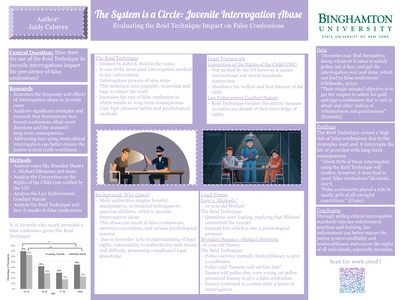
Unveiling the Reid Technique: How Coercive Interrogation Tactics Fail to Protect Juveniles
Sofia Kalaitzis
The United States’ failure to ratify the Conventions on the Rights of the Child (CRC) points to inadequacies in the criminal justice system. This omission reflects a broader failure: the criminal justice system is unable to adequately protect children, particularly regarding the protections against self-incrimination. The Reid Technique, a psychological interrogation method used by police, elicits confessions through a series of manipulative tactics and demonstrates unethical exploitation at the hands of the criminal justice system, undermining the justice system and revealing a failure to protect child rights in accordance with the CRC and Fifth and Eighth Amendments. The legal, psychological, and ethical implications of the Reid Technique on juveniles can be examined using case law, empirical studies, and human rights framework. These practices constitute fundamental violations of due process and require the urgent need for legal reforms to align juvenile interrogation procedures with constitutional and international standards.
-

The Effects of Legislation and Denial on Climate Action
June Kaye
Research worth being explored is the effects of climate activism and denial of the American public on climate policies carried out by American politicians. Answers will be discovered as to why green parties have failed to gain political power, and how and why, psychologically and economically, politicians and fossil fuel executives choose to disregard the voices of American climate protesting. Resulting from this, inaction follows, leading to an output of groups’ unwillingness to change their actions and views based on fixed political stances. Sustainability hasn’t been a mainstream concern for Americans and many are not sufficiently educated on environmental matters. Additionally, lawmakers profit directly from the fossil fuel industry, delaying legislative progress. These findings are insightful and provide perspective as to why and how positive change has failed in the political and social spheres, so that activists can use that information and those findings to search for additional solutions.
-

Basic Income and the Question of Immigration: Evaluating Citizen-Based vs. Residency-Based Proposals
Judy Ke
Basic income is a government welfare program whose primary goal is to alleviate poverty, provide economic security, and reduce inequality. Many non-citizen immigrants, refugees, and asylum seekers would stand to gain benefits if a basic income were implemented in the United States. Yet inclusion of such groups is highly controversial. Some experts argue that including immigrants in a basic income program would increase the immigration rate and cause spending to spike. Drawing on the process of naturalization, tax contributions of citizens and immigrants, and already established arguments, this research paper examines the debate over residency- vs. citizenship-based basic income. In taking the arguments on both sides, this paper will lay down the foundations for whether welfare is a pull factor in immigration and recognize if the politics of a non-citizen basic income plan could decrease the possibility of passing the program.
-

The Soundtrack of Life: A Foray into the Ontology of Musical Works
Emilio Kershner
Historically, classical music has been the domain of compositions and jazz the realm of performance, but the question “what kind of entity is the work in rock music?” has caused some doubt. Strong cases have been made for rock’s claim to recordings, songs, and live performances. This paper will show how disagreements over the ontology of rock give cause to question the very method of constructing higher-order ontologies because of two problems: that of category overlap and that of form/genre conflation. It will be argued that the category overlap problem challenges existing rock ontologies while the form/genre conflation problem gives us a method of constructing a new one. A formal ontology which categorizes musical works based on their form rather than their soundscapes is then posited as the best way to address both issues.
-

Revaluing Work: How the COVID-19 Pandemic Exposed Labor Market Failures and UBI as a Solution
Denis Khrapko
The COVID-19 pandemic forced society to confront a fundamental flaw in labor markets: compensation does not align with social value. Essential workers—healthcare staff, food suppliers, and manual laborers—kept society running yet remained underpaid and overworked, while many white-collar workers retained financial stability and prestige. Beyond waged labor, unpaid contributions like caretaking, child-rearing, and household labor remain invisible in economic accounting despite their necessity for social reproduction and well-being. This project examines how the pandemic exposed the systemic undervaluation of both essential and uncompensated labor and explores Universal Basic Income (UBI) as a corrective measure. Drawing from "Revaluing Work after COVID-19", Graeber’s Bullshit Jobs, and studies on labor mispricing, this research argues that UBI could help rectify market distortions by providing economic stability to essential and unpaid workers alike, redistributing wealth from those able to prioritize lucrative careers to those whose responsibilities—such as caregiving and maintaining households—sustain society yet remain financially unsupported.
-

How Multiplayer Video Games Influence Collaboration and Team Dynamics
Aiden Kim
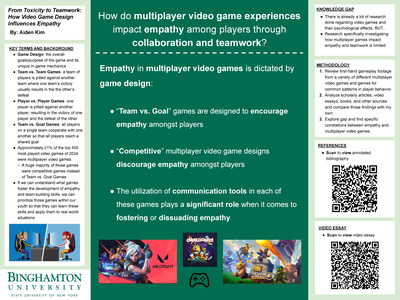
Multiplayer video games create a unique environment where communication and collaboration impact gameplay. While strategizing with others is often essential to reach a goal, factors like game design, communication methods, and gaming culture all play roles in shaping team dynamics. This research explores multiplayer video games and their ability to influence collaboration and develop empathy amongst players. It analyzes how games function through gameplay footage, interviews, internal/external communication methods (like in-game text chats or Discord), and communities formed around these games. By examining team vs team games (such as Valorant), team vs goal games (Overcooked!), and player vs player games (Clash Royale and Fortnite), this project demonstrates how video games are not a monolith; rather, different types of games encourage or discourage teamwork and empathy. Genuinely toxic behavior is more common in competitive games where players face one another, while team vs goal games tend to be more conducive of cooperation and problem-solving. A lack of empathy between players on a team is also correlated with worse individual and team-based performance.
-

The Fall of Communism & Its Effect on the Environment of Eastern Europe
Martyna Kluczynska
How has the environment changed in Eastern Europe since the end of communism in 1990? How has environmental policy changed in these countries? What caused the changes in these policies? Eastern Europe has seen significant changes in the quality of its environment in the past 35 years, and this study will be exploring these changes as well as their causes. The study compares communist environmental policies and current European Union environmental policies. It also compares UNFCCC data sets and charts depicting different environmental factors such as pollution and air quality. The comparison of the policies will offer an explanation for the changes in the environment, and the comparison of the data will determine the effectiveness of the policies. The study also includes peer-reviewed articles that discuss differences and observations of the area under different policies. Ultimately, the study discovers that the quality of the environment in Eastern Europe has significantly improved since the end of communist regimes in 1990, due to many of these former communist countries implementing stricter environmental policies (especially those who went on to join the European Union).
-

The Influence of Food Insecurity on Neurobehaviors
Eylul Koc, Alana Mosher, Ariana Hogan, Justin Handyside, and Marlene Rodriguez
The influence of demographic factors such as gender, income, location, academic level, and age on food insecurity is underexplored. Additionally, food insecurity may be associated with negative neurobehaviors which are detrimental health factors. This study includes demographic questions, questions on food insecurity, resilience, academic motivation, stress, and mental distress. An anonymous online survey was administered through iMessage, Instagram, and Snapchat. Data was analyzed using Pearson’s Correlation Analysis in SPSS version 28.0. Food insecurity is affected by demographic aspects and lower neurobehaviors impacting mental well-being. Results show that there is a negative correlation between the region you live in and the total income of your primary household (p < 0.01), total household income and feelings of depression (p < 0.01), and age and eating limited types of food due to lack of resources (p < 0.01). These results can help establish further programs that can help decrease food insecurity's effects.
-

Henry George: A Forgotten Forefather of Modern Basic Income
Kai Konno
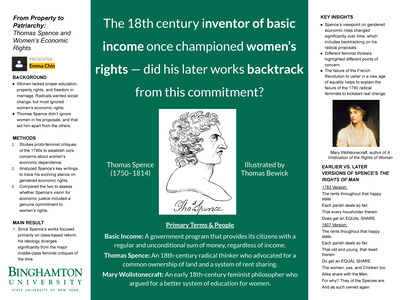
Within the history of Basic Income, Henry George is often viewed as a peripheral figure. Although his works like Progress and Poverty (1879) didn’t focus on cash transfers, a closer reading at his personal correspondences show a surprising support for unconditional cash transfers. As an active political figure in both the UK and the US, his impact on the movement lies in more than just his published works. His efforts in establishing the English Land Restoration League and running for Mayor of New York in 1886 were, at the time, the most impactful and successful attempt at a real implementation of basic income policy and likely inspired the next generation of basic income writers. By comparing George’s works to those of mid 20th century basic income proponents, this paper seeks to recontextualize George as an essential catalyst to the basic income proposals that are often considered in the modern world.
-

Economic Freedom and Universal Basic Income: Compatible or Contradictory?
Elena Kosmas
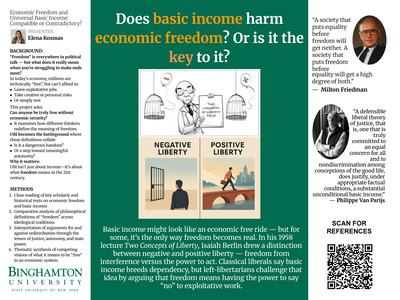
Economic freedom is frequently invoked as an argument both for and against Universal Basic Income (UBI). Classical liberals may object to the policy on grounds of minimal government, demanding the right to retain one's earnings – or what Isaiah Berlin called negative liberty. However, egalitarians argue that true self-determination requires a stable economic base – an argument based on Berlin’s positive liberty. This essay examines how these conflicting conceptions shape political philosophy and economic policy discussions regarding UBI. By referring to Isaiah Berlin, Robert Nozick, Philip Pettit, and Philippe Van Parijs, it examines how the libertarian credentials of UBI depend on whether freedom is conceived as non-interference or resource availability. By reframing the debate, this paper demonstrates that UBI can be perceived as a violation of property rights or as a magnification of the autonomy of an individual. Lastly, these competing definitions reveal how UBI complicates traditional definitions of economic freedom while potentially expanding its meaning.
-

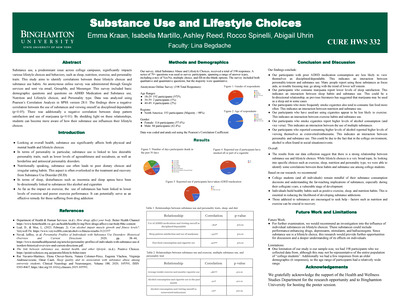
Substance Use and Lifestyle Choices Among College Students
Emma Kraan, Ashley Reed, Rocco Spinelli, Abigail Uhrin, and Isabella Martillo
Substance use, a predominant issue across college campuses, significantly impacts various lifestyle choices and behaviors, such as sleep, nutrition, exercise, and personality traits. This study aims to identify correlations between these lifestyle choices and substance use habits. An anonymous online survey was administered through Google services and sent via email, GroupMe, and Messenger. This survey included basic demographic questions and questions on ADHD Medication and Substance use, Nutrition and Lifestyle choices, and Personality type. Data was analyzed using Pearson’s Correlation Analysis in SPSS version 28.0. The findings show a negative correlation between the use of substances and viewing oneself as disciplined/dependable (p<0.05). There was additionally a negative correlation between sleep pattern satisfaction and use of marijuana (p<0.01). By shedding light on these relationships, students can become more aware of how their substance use influences their lifestyle choices.
-

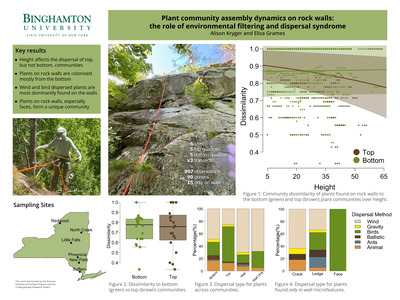
Plant Community Assembly Dynamics on Rock Walls: The Role of Environmental Filtering and Dispersal Syndrome
Alison Kryger
Natural rock walls serve as habitat patches for plants, offering protection from competition, predation, and disturbance. We examined plant community assembly on rock walls, assessing whether colonization is primarily influenced by top or bottom communities and how dispersal methods affect establishment. Across six locations in New York, 97 plant genera were identified, with 15 (15.5%) found exclusively on rock walls, dispersed by wind (48%), gravity (7%), ballistic (3%), ants (6%), and other animals (36%). Sampling along 0–18 meter transects, it was found that similarity to top communities increased with height (p = 0.005), while no significant effect was found for bottom communities. Slope influenced dissimilarity to both top (p < 0.001) and bottom (p < 0.001) communities, with colonization favoring shallower slopes. Micro-features (cracks, faces, ledges) significantly impacted dissimilarity (p = 0.013). These results suggest plant communities are primarily filtered from top communities, shaping their persistence in extreme environments.
-
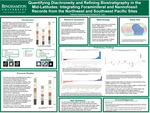
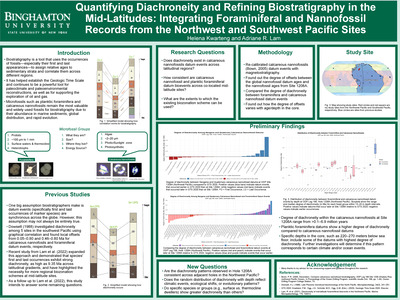
Quantifying Diachroneity and Refining Biostratigraphy in the Mid-Latitudes: Integrating Foraminiferal and Nannofossil Records from the Northwest Pacific
Helena Kwarteng and Adriane Lam
Accurate age models are essential for reconstructing past oceanographic conditions, refining the geologic time scale, and guiding resource exploration. Planktic foraminifera and calcareous nannofossils remain the most reliable tools for first-order age control due to their widespread distribution and rapid evolution. While tropical-subtropical biozonation schemes are well-documented for the Cenozoic, their applicability to mid-latitudes is uncertain due to regional oceanographic variations and species' diachroneity. In the Northwest Pacific, previous studies have documented diachroneity in planktic foraminifera, but no work has investigated nannofossil diachroneity. This study will address this gap by examining whether similar diachronous trends exist in nannofossils and quantifying such diachroneity. This presentation will focus on Site 1208, located under the modern position of the Kuroshio Current Extension, to determine the degree of diachroneity of calcareous nannoplankton compared to species’ calibrated ages from other parts of the world ocean.
Printing is not supported at the primary Gallery Thumbnail page. Please first navigate to a specific Image before printing.